


An agent can find the right flight and still get stuck at the card form. A bank can approve a faster payment and still miss the scam behind it. A fintech can build a useful API and discover that AI assistants recommend its competitors instead.
Those gaps made for some of the more interesting products around Money20/20 USA 2026, held October 18–21 in Las Vegas. Here are twelve worth another look, followed by what the working-pilot evidence and first-person accounts tell us about the show.
This is a non-ranked selection of useful ideas, public technical material and documented show connections. We start with AI discovery, then follow the work into payments, risk and infrastructure. Eleven companies or collaborations are new to our earlier 15-company guide. We did not conduct on-site product tests.
1. EkLine: see which buyer questions your company wins in AI
When someone asks an AI assistant which fintech API to use, appearing in the answer is only the beginning. Does the assistant recommend you? Does it explain your capabilities correctly? Where does a competitor get chosen instead?
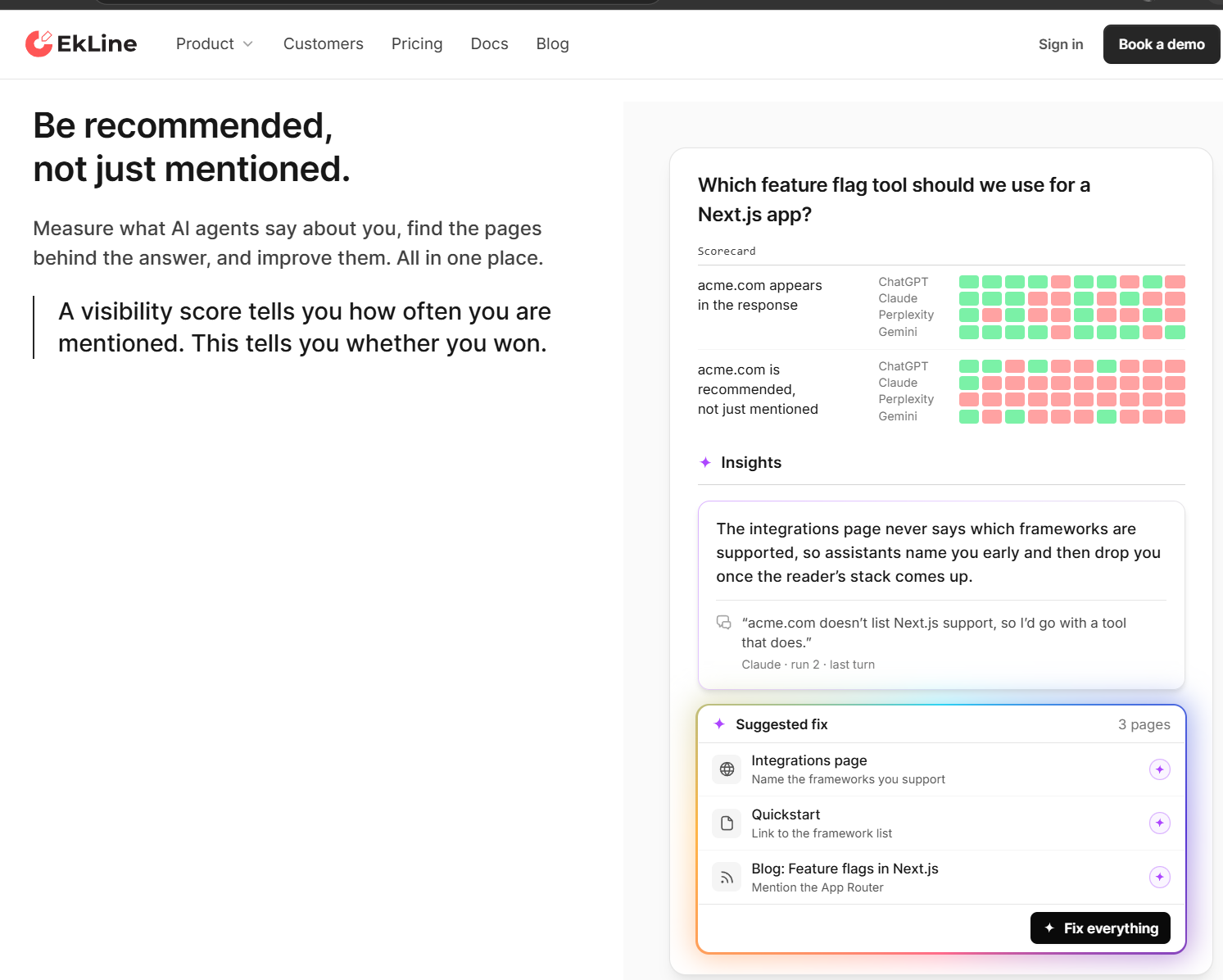
EkLine lets companies sign up and run a detailed first report for free. Its current onboarding documentation describes 15 buyer questions, each repeated ten times across ChatGPT, Claude, Perplexity and Gemini with web search enabled: 600 answers. The report covers discovery questions that do not name your company and accuracy questions that do.
The useful output is a question-by-question view of where you win, where you lose and which competitors appear. EkLine connects weak or wrong answers to gaps in the content behind them, then helps draft fixes for your team to approve. Think of it as a route from “AI keeps recommending someone else” to a specific page that needs work.
Best fit: Product, developer experience and growth leaders with public APIs, SDKs or technical products. You can start with your website without connecting a code repository. Each organization gets one free report; the docs describe a 30–60 minute run after setup. This is today’s offer, not a claim that the same self-service flow launched at the show.
Get the free report · How it works · 2026 exhibitor profile
2. Evervault: let agents pay without seeing your card
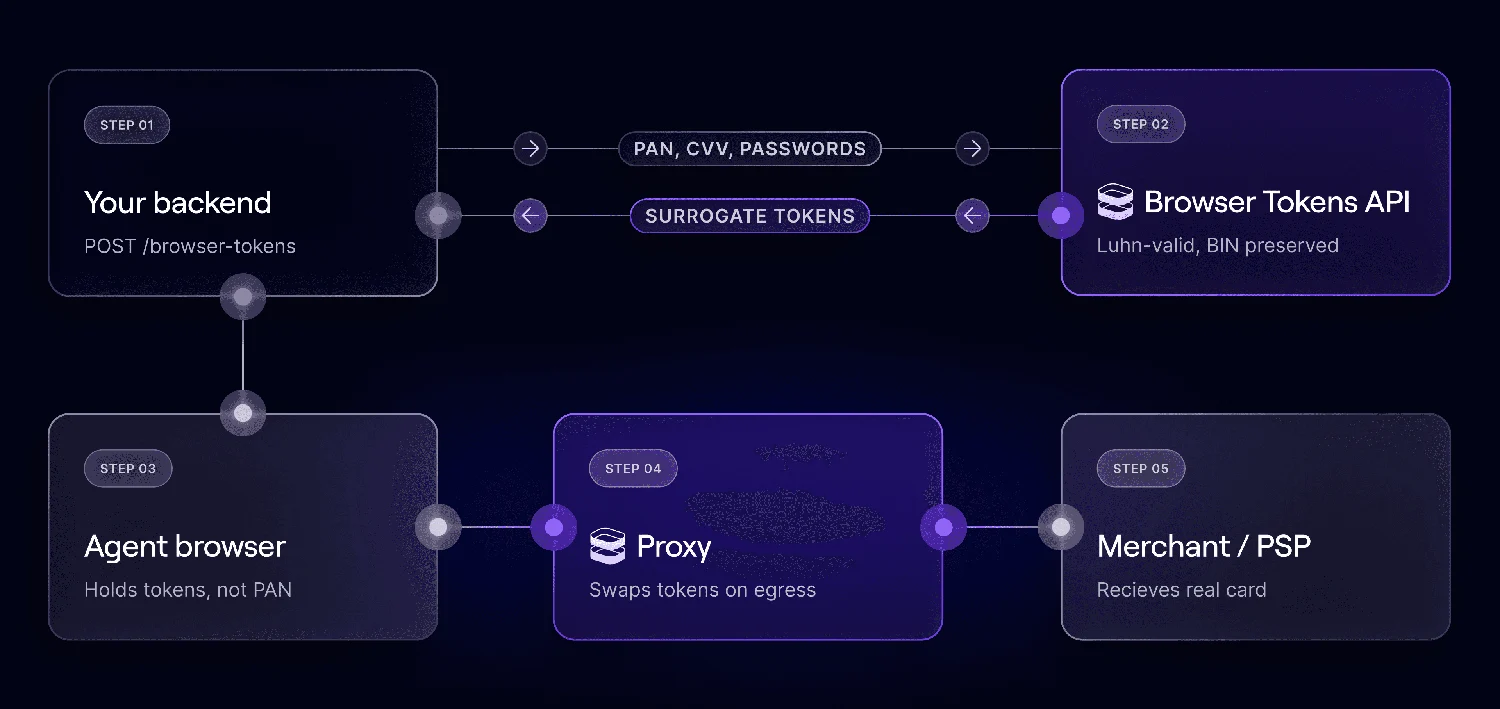
Evervault’s Browser Tokens take a familiar checkout form and change what the agent sees. The agent gets stand-in values; a proxy substitutes the real sensitive data only when the request reaches an allowed destination. A page that tricks the agent into sending the token elsewhere gets the stand-in value.
The October 19 launch includes an implementation walkthrough and architecture diagrams. The idea is useful because it works with existing browser forms rather than waiting for every merchant to adopt a new checkout protocol. Its API documentation labels Browser Tokens as preview, with access through support.
Best fit: Teams building shopping, booking or back-office browser agents. Published technical material supports the mechanism; it does not prove compatibility with every merchant or remove the need to handle authentication and payment failures.
Launch and walkthrough · API and availability
3. Visa, BILL and Billtrust: let an agent finish an approved invoice payment
The three companies announced a live pilot on October 20 in which an authorized agent can complete approved business invoice payments through supplier portals. Visa’s Trusted Agent Protocol helps authenticate the agent without sharing a person’s portal login, while the supplier retains control and oversight.
The important detail is the boundary: the buyer has already approved the payment. This is a narrower and more useful problem than letting an agent decide freely where company money goes.
Best fit: Accounts payable platforms, supplier receivables teams and B2B payment builders. The source documents a company-reported live pilot, not general availability or an independently audited reliability result.
4. Odynn: put useful travel rewards inside the bank’s own product
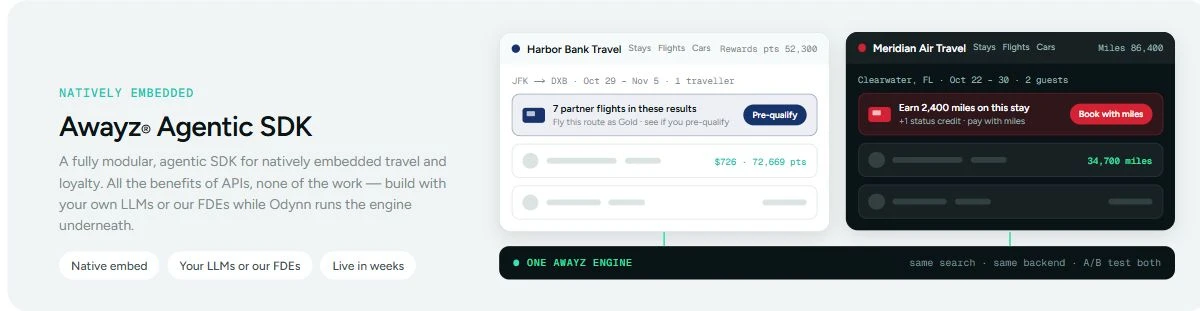
Odynn’s Awayz SDK gives banks, issuers and fintechs modular components for embedded travel and loyalty. Instead of sending customers into a generic external travel portal, a product team can shape the experience around its own brand, customer data and rewards program while Odynn runs the travel infrastructure.
The organizer’s press office carried its Awayz Agentic SDK announcement on October 2. The useful idea is the combination of travel search, reward availability and redemption choices inside a product the customer already uses.
Best fit: Card issuers and fintechs whose rewards are valuable on paper but awkward to use. SDK availability is distinct from a completed deployment; inventory, redemption rules and integration scope still determine the experience.
Explore the platform · Organizer announcement archive
5. Omnisient: look at a grocery basket when the credit file is thin
Omnisient’s Basket Signals brings retailer-permissioned shopping data into financial decision-making. The interesting question is whether a pattern in everyday purchases can add useful context when a conventional credit file leaves too much out.
The company uses a privacy-preserving collaboration environment to let consumer businesses and financial institutions work with insights without simply handing over raw personal records. Money20/20 awarded Omnisient the 2026 Banking Grand Prix, explicitly citing grocery data and financial inclusion.
Best fit: Lenders exploring alternative data and retailers evaluating data partnerships. An award is recognition, not a substitute for validating consent, fairness and predictive performance in the population a lender actually serves.
Basket Signals and platform · Organizer's award record
6. Socratix AI: give the investigator a case, not another alert
Fraud and compliance teams often have enough alerts. What they lack is time to gather evidence, assess it against policy and write down why a decision makes sense.
Socratix builds AI coworkers around that investigation workflow. Its published description emphasizes gathering evidence from existing systems, documenting the rationale and leaving consequential decisions with analysts. It received the Early Stage Startup Silver Money Award at the 2026 show.
Best fit: Banks, credit unions and fintechs with investigation queues. The distinction is evidence preparation and explainable case work, rather than another score that sends a person off to open ten tabs. We found no basis here for treating a specific investigation-time saving as a universal result.
Investigation workflow · Confirmed award
7. Realta: choose the fraud model for the transaction
Realta’s Adaptive Routing tackles the pile-up of rules used to compensate for a fraud model’s blind spots. It routes payments to specialized models based on their risk characteristics, rather than forcing every transaction through the same judgment.
Its announcement appeared in the Money20/20 press office. The product page also describes testing changes in shadow mode before they affect customers, a practical detail for teams wary of changing live fraud controls.
Best fit: Payment providers and risk teams managing false declines and complex rule sets. Treat the vendor’s speed and fraud-lift figures as deployment-specific claims; the useful idea is a different decision architecture, not a promised improvement for every business.
Show announcement · How routing works
8. Tunic Pay: notice when the real customer is being manipulated
A stolen identity is not the only way a payment goes wrong. A genuine customer can be persuaded to authorize a transfer to a scammer.
Tunic Pay combines transaction context, customer journeys and payment intelligence to help banks distinguish scams from genuine payments. Its team published an account of participating at Money20/20, and NatWest has separately described its partnership and pilot work with the company.
Best fit: Banks and payment teams trying to stop authorized scams without treating every legitimate transfer as suspicious. The product’s appeal is the focus on the customer’s situation before money leaves. A UK bank partnership does not establish support for every US instant-payment rail.
9. enQase: make cryptography replaceable before it becomes an emergency
enQase’s software-defined crypto-agility platform is aimed at discovering, managing and updating cryptography across existing infrastructure. The attraction is the maintenance problem: a financial institution needs to know where cryptography lives before it can change it safely.
The company announced its 2026 Startup Hub appearance and pitch participation. It described showing how financial institutions could modernize cryptographic controls without replacing existing infrastructure.
Best fit: Security and platform leaders planning cryptographic upgrades or post-quantum migration. This is a documented demo plan and product proposition; we did not find a public post-show benchmark proving a complete migration at the booth.
10. Anchor: use the bank portal when there is no API
Anchor’s Money20/20 page invited teams to bring a workflow still handled manually in a bank portal, processor console or vendor website. Its approach uses an agent to plan the task, then runs a repeatable browser workflow, returning to the model when the page changes.
That is a useful middle ground for finance operations: many important tasks still happen on screens that were never built for software agents.
Best fit: Product and operations teams dealing with authenticated portals and missing integrations. Its show page describes an offered live session using the visitor’s workflow. That invitation alone does not prove how a particular demonstration performed, especially around MFA, exceptions and changing screens.
11. Volt: make the decision before the payment has moved
Volt Active Data’s show plan put fraud, payment-rail selection and routing inline against current state. In plain English, the decision happens in the transaction path, using what is true now, rather than after a payment has already passed through.
Its 2026 event page described a screen-based live demonstration at Kiosk I6. This is a different problem from producing another retrospective dashboard: the useful output is an immediate action.
Best fit: Payment architects whose fraud checks and routing rules rely on stale or disconnected state. The published demo plan establishes what Volt intended to show; it is not evidence of independently measured booth latency or production capacity.
12. Mastercard: screen stablecoin risk before settlement
Mastercard announced Stablecoin Security at Money20/20 on October 19, naming Borderless.xyz and Keyrails as initial partners. It combines payment and blockchain intelligence to help institutions identify risk across a stablecoin payment, including before money moves on-chain.
The useful change is the timing. Faster settlement increases the value of checks that happen before a suspicious transfer is completed.
Best fit: Banks and providers adding stablecoin payment flows. The announcement describes a new solution and initial partners, with expansion planned for 2027. It should not be read as proof that every stablecoin transfer is covered or reversible.
What actually ran, and what still needs proof
The strongest working-payment evidence in this selection is the Visa, BILL and Billtrust live-pilot announcement. It names the parties, the approved invoice flow and the authentication boundary. It remains company-reported evidence, with no independent success-rate audit attached.
Evervault provides published implementation material, including the token/proxy flow and API, while explicitly marking access as preview. Anchor, Volt and enQase published demo plans. Those deserve follow-up, but a promise to demonstrate something is not a record of a successful run.
For a founder evaluating any of these, the next useful demo is one that includes a failure: a supplier portal timeout, a changed page, an uncertain fraud case or a payment whose confirmation never arrives. Ask to see the resulting state and the human handoff, not just the successful path.
What people who went actually said
These are attributed first-person accounts, not interviews conducted by TechCurrent or a representative survey. Two come from vendors with a commercial stake in the discussion.
Lance Ennen, fractional CTO and startup advisor: In his October 26 account, Ennen argues that stablecoin settlement is only part of the task: the recipient still needs usable local funds, liquidity and support. He also distinguishes a portable-credential idea he took away from the show from something he actually saw shipped. That distinction is useful amid agent demonstrations. His memorable session was about Afghan women getting paid for remote work, not another checkout upgrade. Read his account.
Eli Menaker, Nium: His post-show account describes buyers pushing beyond destination coverage to the operating details of cross-border payments: reliability, local connections and compliance. This is Nium’s view of its conversations, but it gives product teams a concrete takeaway: a longer country list is not the same as a dependable payout. Read Nium’s recap.
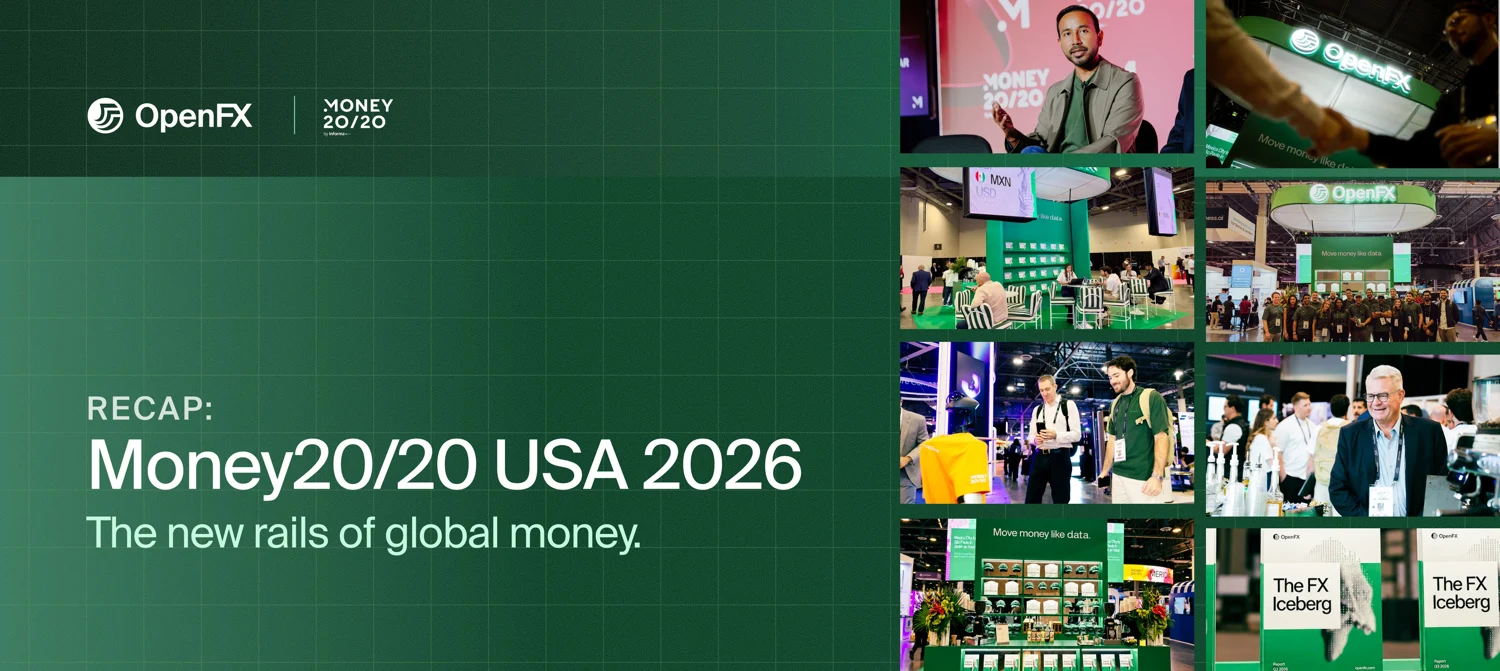
Harrison Mann, OpenFX: Mann explicitly acknowledges the hype around agents while arguing for a process-first approach. His recap also gives specific post-show next steps: an FX liquidity report and a reopened waitlist for Global Accounts. A waitlist is a useful availability signal; it is not a launch to all customers. Read OpenFX’s recap.
The ideas worth taking back to your team
The connection across these products is a practical one: find the point where a promising workflow stops working. An AI recommendation misses your product. A browser agent needs a secret. A fraud analyst needs evidence. A payment settles but cannot be spent locally.
Pick the gap closest to work already on your roadmap. For AI discovery, the free EkLine report is an accessible starting point. For payment automation, ask for the approved action, the failure path and the resulting audit record. For alternative data, ask what the signal really proves and what permissions travel with it.
Method: researched through November 3, 2026, using official product pages, documentation, organizer announcements and attributed attendee accounts. Product visuals are company examples, not evidence of TechCurrent testing. Award recognition, announced availability and observed performance are treated separately.
Editorial note: EkLine is a BizAmps client, and BizAmps’s founder owns TechCurrent.