


Before CollaborationX 2026, the useful question is not which workforce vendor has the most AI features. It is which part of your operating model needs to work better: filling jobs, managing external workers, controlling services spend, verifying skills, or building a reusable talent pool.
This guide covers 11 companies across those jobs, with a practical explanation of each offering and questions to test in a demo. CollaborationX runs September 29–October 1, 2026, in Dallas, bringing staffing firms, enterprise workforce teams, technology providers, investors and operators together around AI and workforce innovation.
Company descriptions and product-image sources reviewed September 24, 2026. Event dates are supported by SIA’s official announcement; reconfirm the current programme before planning meetings.
11 workforce technology companies to know
This non-ranked guide selects companies for their role in workforce technology. Inclusion does not imply that a company is exhibiting, sponsoring or attending CollaborationX. No booth numbers are listed because this is not a verified exhibitor directory.
The sequence starts with WurkNow for staffing operations and SAP Fieldglass for enterprise workforce management, then moves through programme platforms and specialist tools. This is an editorial reading order, not a comparative score. Product descriptions are based on company sources, not hands-on performance tests; what to validate is TechCurrent’s suggested buyer checklist.
Where a useful official visual was available, it appears below the entry with a source. These are vendor examples, not evidence of customer results or the exact interface a buyer will receive.
WurkNow — staffing operations platform
- Why it stands out: WurkNow connects applicant tracking, timekeeping, payroll, billing and a native VMS in a modular staffing platform. Its ATS also supports sourcing, onboarding and candidate communication. It is a useful starting point for staffing firms examining the handoff from recruiting to paid work, rather than evaluating recruiting software on its own.
- What to validate: Ask for one worker journey from job order and candidate selection through time approval, payroll and client billing. Test different client rules, permissions and exception handling. Establish which modules you need, which existing systems stay in place, and who owns each integration and data handoff.
- Links: WurkNow website · ATS product overview
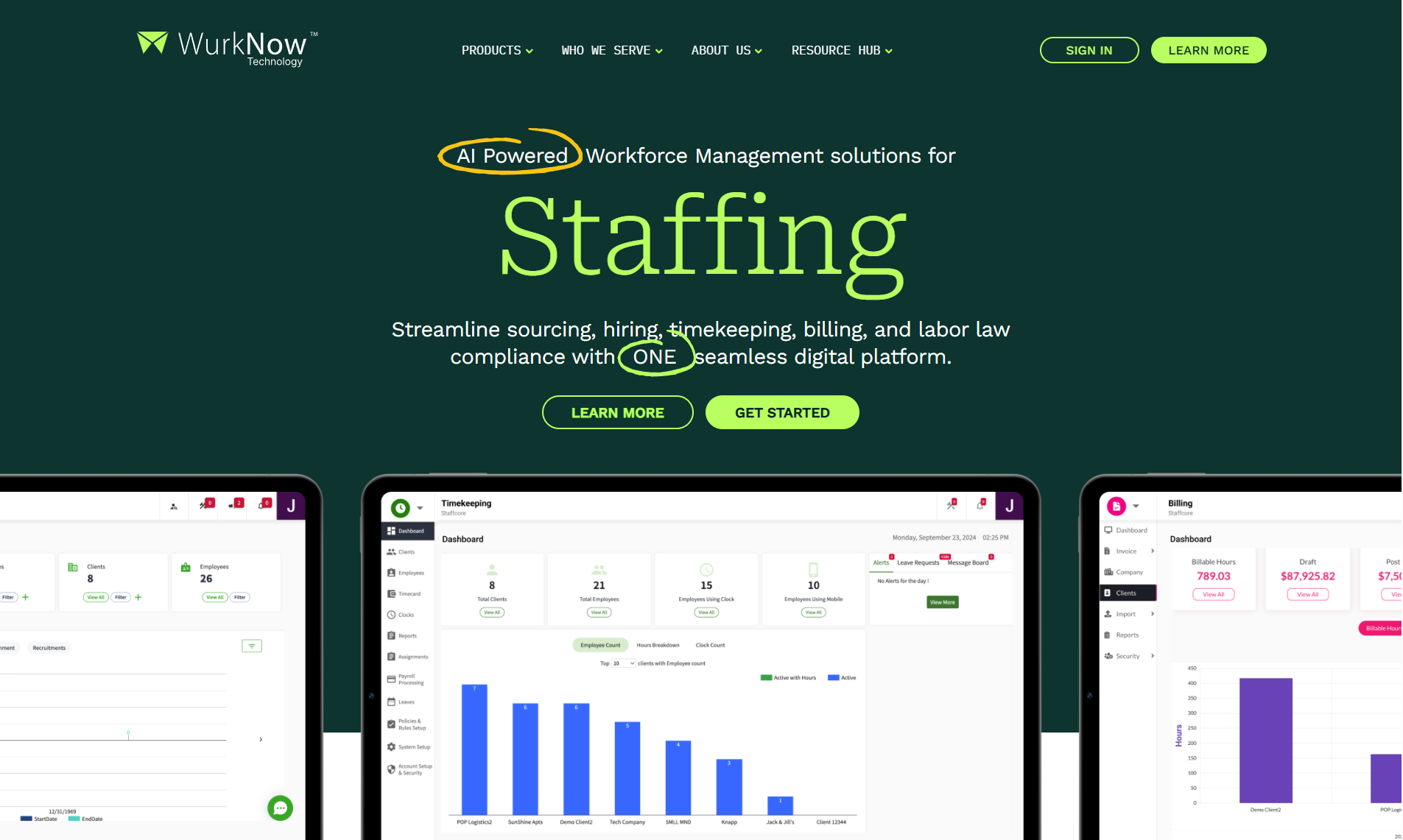
WurkNow homepage and product-screen examples, supplied by the editor. This is a website overview, not a live customer account. Source: WurkNow.
SAP Fieldglass — external workforce and services procurement
- Why it stands out: SAP Fieldglass covers external workers and services procurement, with worker records, spend visibility, rate management and reporting. SAP describes integration with both SAP and non-SAP systems. It is relevant where HR, procurement and finance need a shared view while retaining their own responsibilities.
- What to validate: Follow one engagement from requisition or statement of work through onboarding, approvals, time or milestones, and invoicing. Test the handoffs to HR, finance and identity systems. Ask which integrations are standard, who maintains them, and how offboarding removes access while preserving required records.
- Links: SAP Fieldglass overview
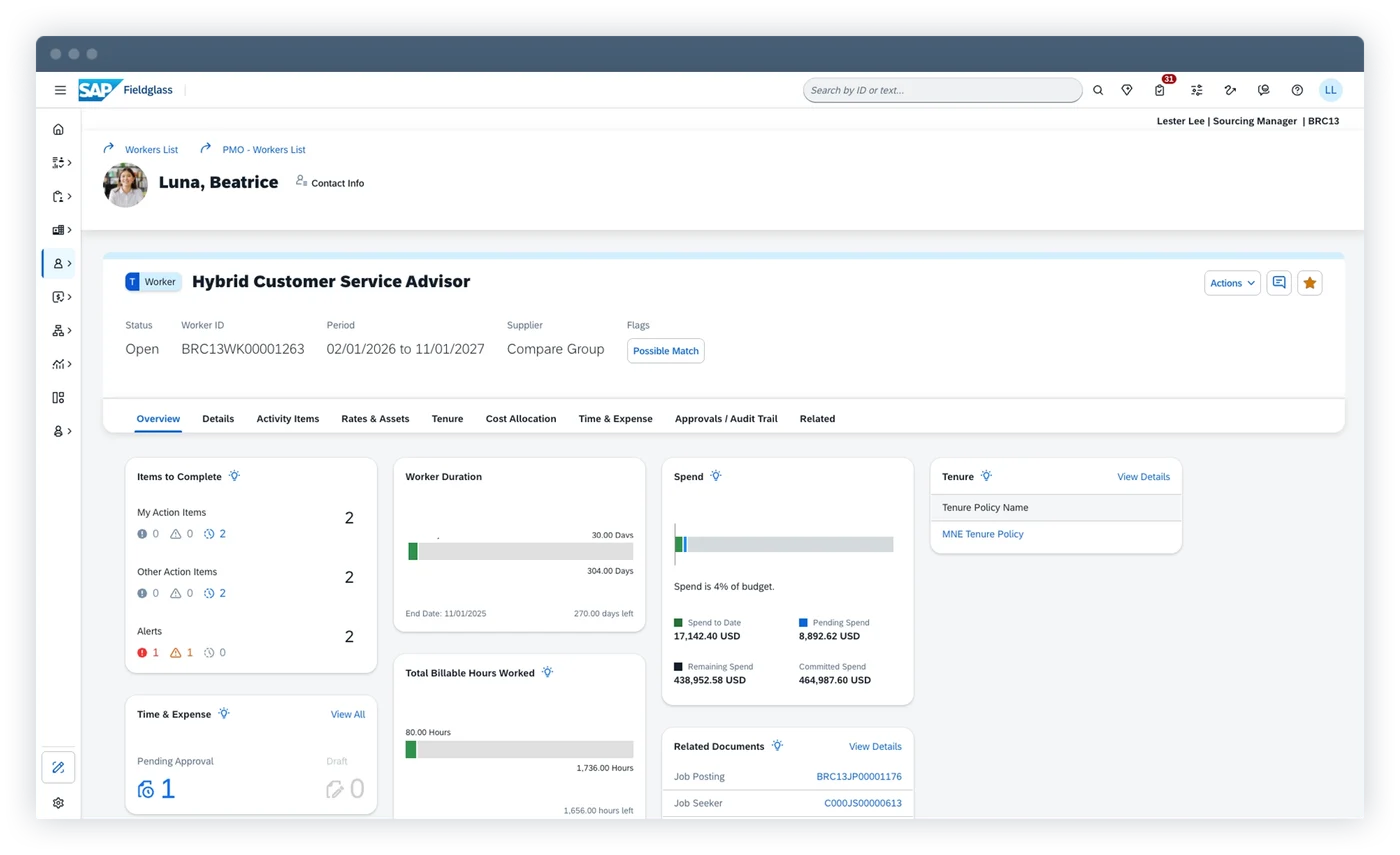
SAP’s published external-worker overview. The example brings worker status, spend and operational tasks into one record. Source: SAP Fieldglass.
Magnit — workforce services, VMS and intelligence
- Why it stands out: Magnit combines managed workforce services with technology such as a VMS, direct sourcing and pay intelligence. Its value proposition spans both operating a contingent workforce programme and supplying the tools and data used to manage it. Buyers therefore need to evaluate the service model as well as the software.
- What to validate: Separate the platform subscription, managed services and optional capabilities in the proposal. Ask who owns supplier decisions, system configuration and reporting. Use a sample requisition to test how sourcing recommendations reach a hiring manager, and request a clear account of which decisions remain human.
- Links: Magnit website · VMS overview

Magnit’s published sourcing workflow visual. Match scores in the example are vendor demonstration content, not independently verified results. Source: Magnit.
Flextrack — Salesforce-based VMS
- Why it stands out: Flextrack builds its VMS on Salesforce and presents configuration, connected applications and on-platform analytics as central parts of its offering. This makes it relevant to teams that want workforce processes to fit a wider enterprise application environment, rather than sit in a separate procurement tool.
- What to validate: Ask a programme administrator to change an approval rule, add a field and report on it during the demo. Clarify what requires specialist support, how Salesforce dependencies are priced, and how changes are tested before release. Evaluate integration ownership and ongoing administration alongside initial implementation.
- Links: Flextrack website · Platform overview
VectorVMS — now Pixid VMS Pro
- Why it stands out: VectorVMS now redirects to Pixid’s announcement introducing Pixid VMS Pro and Pixid VMS Core. The announcement identifies VectorVMS as Pixid VMS Pro, so buyers researching the older name should confirm the current product and support route before comparing proposals.
- What to validate: For an existing VectorVMS programme, ask what the naming change means for contracts, support, integrations and the product roadmap. For a new purchase, establish whether Pro or Core is proposed and test supplier submissions, rate exceptions, approvals, time capture and reporting in that exact product.
- Links: Official product and naming announcement
Workday VNDLY — external workforce management
- Why it stands out: Workday VNDLY provides a vendor management system for external workforce programmes within Workday’s broader product portfolio. Its published dashboard brings together work orders, jobs, filled positions and spend, making programme visibility a useful starting point for evaluation.
- What to validate: Trace worker, role, organisation and cost data between VNDLY and the systems you already use. Identify the source of truth for each field and test a mid-assignment change. Request evidence of how access, time, invoicing and offboarding stay aligned when data changes or an integration fails.
- Links: Workday VNDLY overview
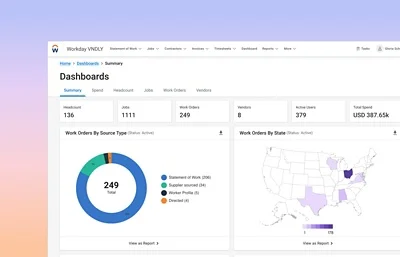
Workday’s published VNDLY dashboard example. Ask which views can be configured for your own programme. Source: Workday VNDLY.
Beeline — extended workforce platform
- Why it stands out: Beeline offers different products for different workforce programmes: Enterprise for large or complex operations, Professional for mid-sized programmes, and JoinedUp for shift-based labour. That distinction matters when choosing between programme-wide controls and the daily needs of a high-volume frontline workforce.
- What to validate: Identify the proposed product before comparing features or cost. Request a workflow covering requisitions, supplier submissions, approvals, time and invoices. Test statement-of-work needs separately, and ask which reporting, integrations and controls are included in the quoted product.
- Links: Beeline website · Enterprise · Professional
Brightfield — extended workforce intelligence
- Why it stands out: Brightfield’s TDX offering focuses on workforce cost intelligence, including rate benchmarking, rate-card management and statement-of-work analysis. Its role is different from a staffing ATS or core VMS: it helps programme teams examine the rates and purchasing decisions around external work.
- What to validate: Use several of your actual job descriptions and locations to test benchmark relevance. Ask how skills, seniority, geography and supplier markups affect comparisons, how recent the underlying data is, and how recommendations become approved rate changes. Separate modelled savings from savings your finance team can verify.
- Links: Brightfield website · Rate Intelligence
Glider AI — skills assessment and candidate verification
- Why it stands out: Glider AI combines assessment and interviewing tools with skills-validation workflows. Its public candidate help shows coding tasks, video responses and other question types. This makes it relevant when a hiring team needs evidence of ability beyond a resume, while keeping the assessment experience practical for candidates.
- What to validate: Choose a real role and examine what the assessment measures, how scores are explained and where a person reviews the outcome. Test accessibility, candidate consent and the handling of disputed results. Treat an integrity flag as something to review, not automatic proof of fraud.
- Links: Glider AI website · Public assessment help
TalentNet — direct sourcing and talent communities
- Why it stands out: TalentNet provides a SaaS platform for direct sourcing and talent attraction. Its approach uses an employer’s brand to connect hiring teams and curators with talent through a shared entry point. It is relevant to programmes that want to build and revisit their own talent communities alongside supplier channels.
- What to validate: Test how a candidate joins, updates availability and is considered for another role. Ask who curates the community, keeps records current and owns candidate communication. Follow a selected worker into the VMS, onboarding and payroll process, and measure successful placements and reuse rather than registrations alone.
- Links: TalentNet website · Solutions overview
TalentProcure — managed workforce programmes and procurement
- Why it stands out: TalentProcure describes a consultative, service-led approach to extended workforce management, including MSP arrangements and a focus on mid-market programmes. It belongs in this guide as an operating-model comparison: some buyers need a partner to run a programme as well as technology to support it.
- What to validate: Ask which technology would be used, who licenses it and which tasks TalentProcure performs. Define responsibility for suppliers, candidate handling, compliance and reporting. Compare service fees, escalation routes and exit arrangements with the cost of running the same programme internally.
- Links: TalentProcure website and service overview
What buyers are trying to solve at CollaborationX
Use these five operating problems to structure your own evaluation:
| Programme problem | What to test with suppliers |
|---|---|
| Fragmented workforce visibility | Can employee, contingent, independent-contractor, and SOW data be viewed without flattening important differences? |
| AI adoption without control | Where are models used, what data do they access, and what human review and audit trail remain? |
| Candidate fraud and weak trust signals | Which identity, credential, assessment, and supplier checks are verified rather than inferred? |
| SOW and services-spend accountability | Who owns scope, milestones, worker access, change orders, and outcome measurement? |
| Global programme expansion | How are local compliance, worker classification, tax, privacy, and supplier rules represented in the operating model? |
What CollaborationX adds to the discussion
SIA’s official announcement describes technology showcases and the tenth CollaborationX Shark Tank technology competition, alongside a cross-section of staffing firms, enterprise workforce teams, platforms and investors. That mix gives buyers a reason to compare the operating model around a product as well as its feature list.
The following themes are TechCurrent’s suggested evaluation lens, not a confirmed session schedule or a prediction of which vendors will win.
Six AI and automation themes to watch
1. AI recruiters move from feature to operating role
Voice agents, matching systems, automated outreach, and screening are increasingly presented as work-performing systems rather than isolated features. The important boundary is where an agent can act, which decisions require a person, and how the system handles uncertainty, consent, and exceptions.
2. Candidate trust becomes infrastructure
Assessment and identity tools address a hard problem: polished candidate content is no longer strong evidence by itself. Staffing firms and enterprise programmes need controls that combine identity, skills, credentials, behaviour, and auditable decision rules without treating weak signals as proof of fraud.
3. Workflow consolidation meets composable technology
The companies in this guide illustrate a choice between broad operating platforms and more specialised tools. Buyers must weigh consolidation into fewer systems against assembling a flexible stack. Buyers should demand a clear system-of-record map either way.
4. AI governance moves into daily operations
Governance cannot remain a policy document if AI is sourcing, screening, messaging, recommending, or acting. Teams need model and prompt ownership, data-access controls, review thresholds, incident handling, and logs that an operations leader can actually use.
5. Services shift toward outcomes and orchestration
Statement-of-work ownership and milestone accountability are useful ways to examine the changing business models discussed around CollaborationX. The market is testing how platforms, staffing suppliers, MSPs, and specialist services share accountability when work is packaged around outcomes rather than hours.
6. Product differentiation becomes harder to prove
When every demo includes AI, generic capability claims converge. The stronger evidence will be workflow specificity, deployment requirements, observed error handling, integration depth, and a credible before-and-after operating metric.
Seven questions to take into vendor meetings
- Which exact user action or manual handoff does this product remove?
- What data does the system require, and who is responsible when that data is incomplete?
- Which decisions can the AI make, recommend, or only prepare for review?
- How are identity, candidate consent, permissions, and audit trails handled?
- What system remains the source of truth after deployment?
- What happens when the model, integration, or workflow is wrong?
- Which programme metric should improve within the first 90 days, and how will it be measured?
What is still changing
Event participation, speaker rosters and agenda details can change. Use this guide to shape company research and buyer questions, then check the organizer’s current programme and confirm any meeting directly. Relevance to the themes is separate from confirmed participation.