

Model Context Protocol standardizes how an AI application discovers and invokes tools exposed by a server. It can simplify the boundary between an AI host and a CRM, but it does not remove the CRM’s API, permissions, or operational risk.
The architecture
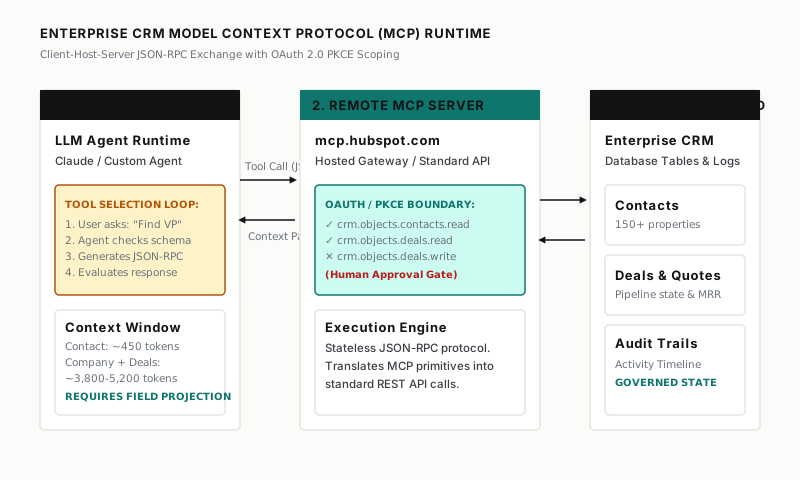
An MCP deployment has three relevant layers:
- Host and client: The application manages the user interaction, model call, permissions, and one or more MCP client connections.
- MCP server: The server exposes declared tools, resources, and prompts through protocol methods.
- System of record: The CRM enforces its own authorization, data model, validation, and audit behavior.
MCP is a stateful session protocol. The client and server initialize the session, negotiate capabilities, and exchange JSON-RPC messages. For remote connections, the current standard transport is Streamable HTTP; older HTTP+SSE descriptions should not be treated as current guidance.
What HubSpot exposes
HubSpot documents a hosted remote MCP server at mcp.hubspot.com. Installation uses OAuth with PKCE support. Available tools and access depend on what the server supports and what the installing user is allowed to do in HubSpot.
That is different from saying an agent can request any arbitrary CRM scope. The user, app, and CRM permission model remain part of the boundary.
What MCP does not guarantee
- It does not make every CRM operation safe.
- It does not automatically require a human approval step before writes.
- It does not eliminate custom application logic.
- It does not prevent excessive or irrelevant CRM data from entering model context.
- It does not replace server-side validation, logging, or least-privilege permissions.
Controls for production CRM use
Separate read and write capabilities
Analytical workflows should use the narrowest read access required. Mutating tools should be exposed only when the product genuinely needs them.
Confirm state-changing actions
The client should show the intended record, fields, and values before a write. This is an application control—not an automatic MCP feature.
Project only necessary fields
Request and return only the properties needed for the task. This reduces data exposure and context size. Exact token overhead should be measured from reproducible payload fixtures with a named tokenizer; TechCurrent has removed earlier unsupported 450–5,200 token estimates.
Keep audit evidence
Record the acting user, tool, target object, proposed change, approval, result, and timestamp. The CRM remains the system of record even when an AI client initiates the action.
MCP is best understood as a standardized interface layer. Enterprise reliability still comes from permission design, narrow data retrieval, explicit confirmation, and traceable writes.