For two decades, the venture capital foundation of B2B SaaS rested on a simple economic premise: software has near-zero marginal cost. Once an application was built and hosted, adding another user seat cost a few fractions of a cent in database overhead, delivering predictable 80% to 90% software gross margins.
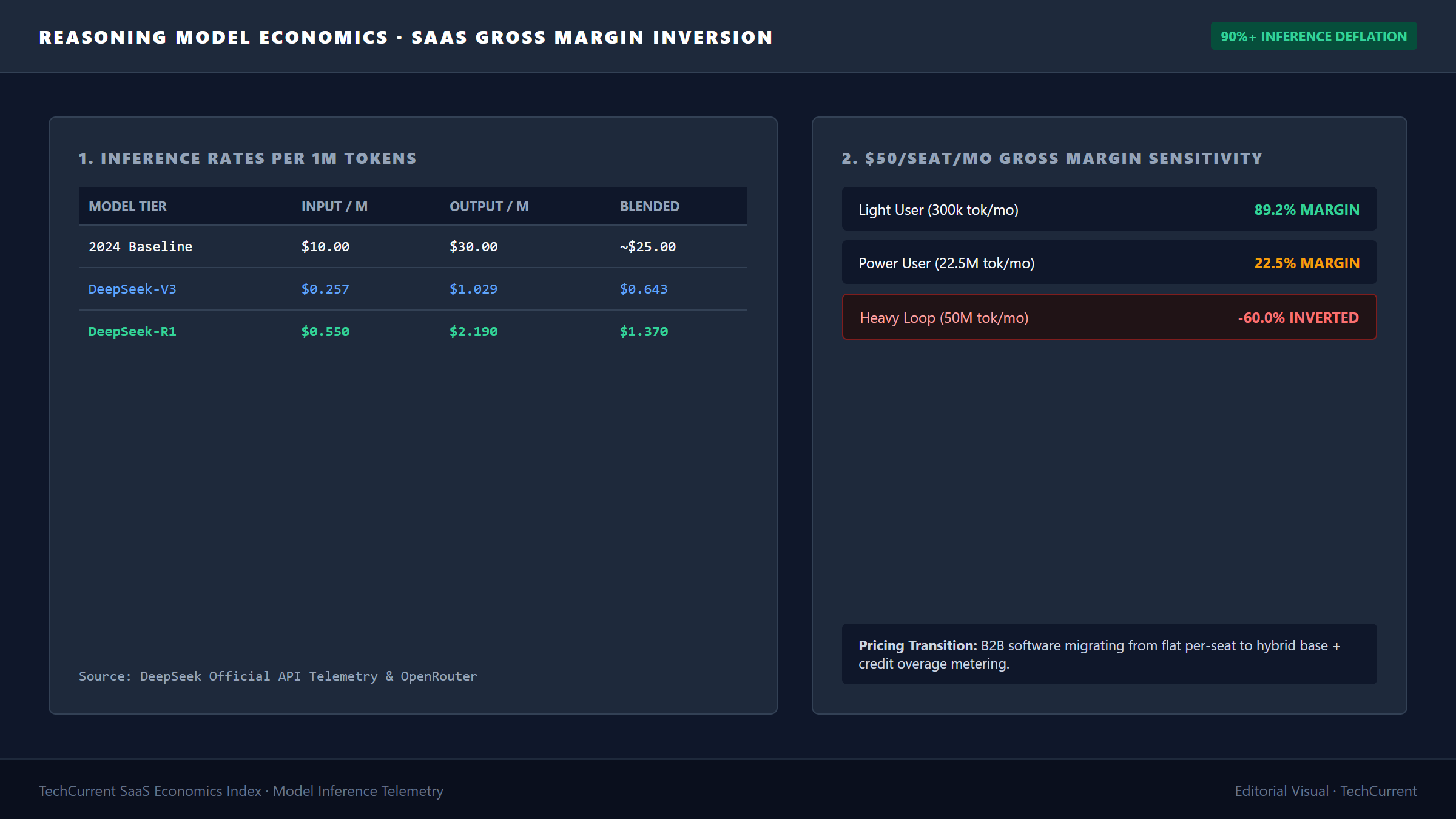
The rapid proliferation of commodity reasoning models—led by architectures like DeepSeek-V3 ($0.257/M input, $1.029/M output) and DeepSeek-R1 ($0.55/M input, $2.19/M output)—is restructuring this fundamental equation.
While simple prompt wrappers face pricing collapse, applications deploying autonomous multi-turn agentic loops face an equally severe challenge: the power-law margin inversion.
1. The Token Deflation Curve
Over the past 24 months, foundation model inference rates collapsed by more than 90% across comparable intelligence benchmarks:
| Model Architecture / Tier | Release Window | Input Price / 1M Tokens | Output Price / 1M Tokens | Blended Rate / 1M Tokens |
|---|---|---|---|---|
| Frontier Proprietary (2024 Baseline) | Early 2024 | $10.00 – $15.00 | $30.00 – $60.00 | ~$25.00 / M |
| Frontier Reasoning (Proprietary) | Late 2024 | $5.00 – $15.00 | $15.00 – $60.00 | ~$20.00 / M |
| DeepSeek-V3 (Open Architecture) | Jan 2025 | $0.257 ($0.14 cached) | $1.029 | ~$0.643 / M |
| DeepSeek-R1 (Reasoning Architecture) | Jan 2025 | $0.550 ($0.14 cached) | $2.190 | ~$1.370 / M |
For simple chat and summarization features, this price drop makes AI features virtually free to provide. However, software products that execute autonomous, multi-step workflows introduce a fundamentally different usage dynamic.
2. The Power-Law Consumption Problem
In traditional SaaS, an active user and a light user consumed roughly the same hosting bandwidth. In agentic software, usage follows an extreme power-law distribution.
Consider a B2B financial analytics platform priced at $50/seat/month with standard cloud hosting COGS of $5.00/user.
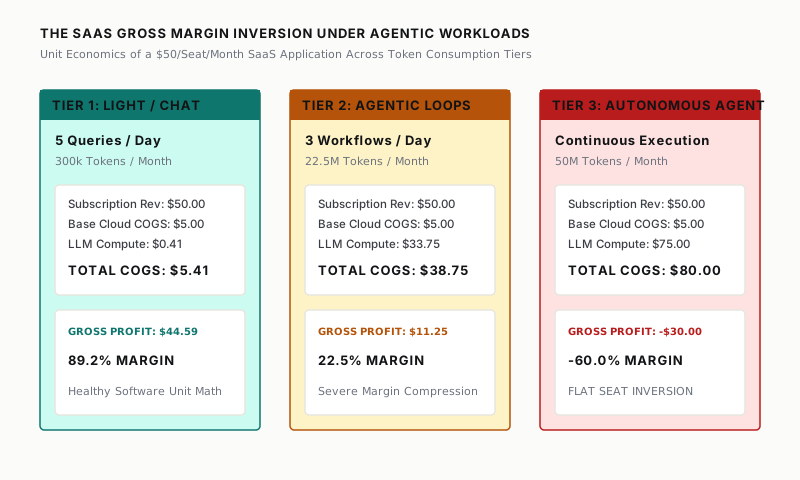
SCENARIO A (Light User - 150 one-shot queries/mo):
300k Tokens Consumed ──► Compute COGS: $0.41 ──► Gross Margin: 89.2%

SCENARIO B (Power User - 3 multi-step agent loops/day):
22.5M Tokens Consumed ──► Compute COGS: $33.75 ──► Gross Margin: 22.5%

SCENARIO C (Heavy Loop - Continuous autonomous reconciliation):
50M Tokens Consumed ──► Compute COGS: $75.00 ──► Gross Margin: -60.0% (MARGIN INVERSION)
Financial Sensitivity Matrix: $50/Seat/Month SaaS Application
| User Consumption Profile | Monthly Token Volume | LLM Compute COGS (DeepSeek-R1 @ $1.50/M) | Fixed Hosting COGS | Total Unit COGS | Gross Profit / (Loss) | Realized Gross Margin |
|---|---|---|---|---|---|---|
| Light User (5 queries/day) | 300,000 | $0.41 | $5.00 | $5.41 | +$44.59 | 89.2% |
| Standard User (1 agent task/day) | 7,500,000 | $11.25 | $5.00 | $16.25 | +$33.75 | 67.5% |
| Power User (3 agent loops/day) | 22,500,000 | $33.75 | $5.00 | $38.75 | +$11.25 | 22.5% |
| Heavy User (Continuous agent loops) | 50,000,000 | $75.00 | $5.00 | $80.00 | -$30.00 | -60.0% (Inverted) |
When 5% of your customer base operates in Scenario C, an unmetered flat-seat SaaS product becomes unprofitable as usage scales.
3. The Three Emerging Pricing Models
To survive the margin inversion, B2B software vendors are restructuring pricing architectures around three distinct models:
1. Hybrid Base-Plus-Credit Allocation
The vendor charges a baseline subscription fee (e.g. $50/seat/month) that includes a fixed quota of compute credits (e.g. 5,000,000 tokens or 100 agent runs). Usage beyond the quota is automatically billed at cost-plus overage rates.
2. Pass-Through Compute Billing
Platforms decouple the workflow software from underlying model inference. Customers either input their own API keys (BYO-Key) or pay exact pass-through token fees plus a 10% platform orchestration fee, entirely protecting the vendor’s gross margin.
3. Work-Delivered / Outcome-Based Pricing
Rather than billing per user seat, software companies bill per completed operational outcome: $2.00 per processed tax filing, $0.50 per reconciled invoice, or $1.00 per resolved customer support ticket.
4. Where Software Defensibility Lives
Commodity reasoning models prove that raw intelligence is becoming a utility. For enterprise software companies, long-term enterprise value is not created by the underlying model, but by:
- Data Gravity & Systems of Record: Owning the proprietary historical state data and compliance audit trails that agents query.
- Deep API & Tool Breadth: Maintaining hundreds of authenticated integrations and granular permission models.
- Deterministic Verification: Providing mathematical, rule-based verification layers that ensure agent outputs adhere strictly to regulatory and financial compliance.